
Ghosts of Nightshifts Past
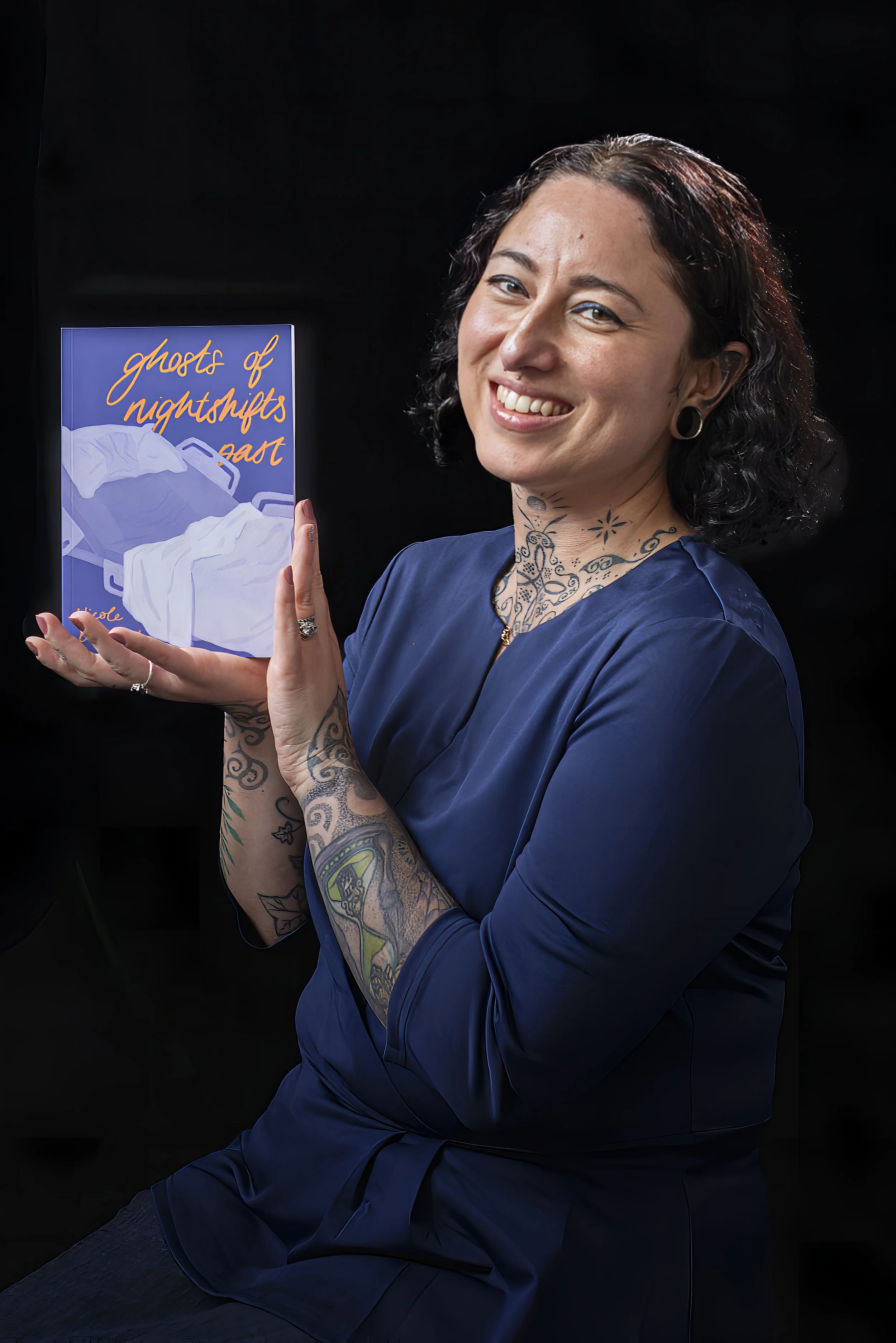
Ghosts of Nightshifts Past is a vivid, compassionate poetry chapbook drawn from the strange, exhausting and often deeply moving world of healthcare.
From the frantic resus bay of A&E to the quieter corridors of hospice care, Nicole Durman writes from the perspective of a nurse who has spent years alongside patients, families and colleagues at moments of crisis, vulnerability and change.
These poems are neither sentimental nor clinical. They are observant, darkly funny, tender and sometimes unsettling, capturing the language, rituals and emotional realities of hospital life from the inside.
At the heart of the collection is a fascination with what happens when professional composure meets private feelings: the things nurses say, the things they cannot say, and the memories that linger long after a shift has ended.
With humour, humility and an eye for the telling detail, Ghosts of Nightshifts Past offers readers a rare glimpse behind the curtain of healthcare, and asks us to look again at the people who care for us when we are at our most vulnerable.
Publisher: Dithering Chaps
Format: Poetry chapbook
Length: 64 pages
Publication date: July 2025
ISBN: 978-0-9574538-8-3
Publication details
About the Author - Nicole Durman
Nicole Durman has lived in Somerset for over a decade, having moved from the USA in 2011.
She is a nurse, a prize-winning poet, and a current member of her local poetry group, Fire River Poets.
Nicole has previously been published in Balancing on a Bootheel: New Voices in Poetry from Southeast Missouri, and in Lines in the Sand, an anthology of poetry and flash fiction.
Her debut collection, Ghosts of Nightshifts Past, is inspired by her career, which has spanned both A&E and hospice nursing.
In the video below, Nicole reads, “accident/emergency” from Ghosts of Nightshifts Past.
Reviews for ‘Ghosts of Nightshifts Past’
-
"Nicole Durman’s compelling collection takes us on a vivid tour of spaces in which lives teeter. Whether set in A& E or in the hospice – where the cared for (and cared about) patients and colleagues are paramount – the poems embody the empathy, self-questioning, and sheer precision of a nurse practised in measuring, observing and noting details. Here is the medical context of ECGs, dosages and procedures set alongside powerful evocations of human vulnerabilities and pressures of time: a constant walking on brinks. In this deftly accomplished debut, Durman’s powerful directness of language and depth of vision never fail to keep the reader riveted."
Kate Griffiths
About Katie:
Katie Griffiths grew up in Ottawa, Canada, in a family originally from Northern Ireland. In 2024 she was awarded the Gregory O’Donoghue International Poetry Prize. She is author of The Attitudes, published by Nine Arches Press, and the first-prize winning pamphlet My Shrink is Pregnant from Live Canon. She won second prize in 2018’s National Poetry Competition, and in 2016 was published in Primers Volume One by Nine Arches Press.
-
Lazarus, risen from the dead, and Lachesis, Greek goddess of fate – shears in pocket, haunt the corridors, wards and rooms of this collection in two parts, hospital A&E and hospice. God as intimate Friend hovers in the wings. A startling collection, that throws us headlong into a world of mysterious phenomena, procedures and medical terms. A nurse's biting humour and objectification of patients defends against the indignities of damaged and dying bodies, icing over a substantial tenderness, while the numinous keeps insisting itself into the foreground:
You don't know what eternity is.
I've glimpsed it. Gripped its narrow handle.
The space of a moment between swallows.
Hélène Demetriades
About Hélène:
Hélène is a poet and psychotherapist living in South Devon. Her debut collection, ‘The Plumb Line’ was joint winner of the Hedgehog Press Poetry Collection Competition 2020. She studied English Literature at Leeds University, and trained and worked as an actor in her twenties. She has been widely published in poetry magazines, anthologies and webzines. In 2022 she won The Silver Wyvern, Poetry On The Lake, for a single poem, (judged by Robert Seatter). She has been short-listed in the Bridport, long listed in the National, and highly commended in the Fool For Poetry Chapbook Award, (Munster Literature, all in 2023.
-
Ghosts of Nightshifts Past grips the reader from the outset.
Each poem is like a beautifully constructed short film that brings a medical episode or patient to vivid life, immersing us in the front line of an expert nurse’s world and – thanks to the poet’s skill - taking us on journeys beyond.
The voices in these poetic bulletins from A&E and the hospice are grounded in gritty reality and simultaneously open out to mythopoeic dimensions.
We face first and last things thanks to Nicole Durman’s unflinching, compassionate eye.
With not a trace of sentimentality her experiences become ours.
Graeme Ryan
About Graeme:
Graeme Ryan is a playwright, teacher and prize-winning poet whose acclaimed debut collection Valley of the Kings came out in 2022. He is a member and online MC for Fire River Poets and judges the annual Page is Printed poetry competition in Taunton.
-
‘This must be open heart surgery, surely’ by Matt Brydon
Ghosts of Nightshifts Past: a nurse’s poems, from A&E to hospice, Nicole Durman
Nicole Durman’s debut Ghosts of Nightshifts Past tracks the initiation of a nurse who pledges to ‘give it six months’ as she learns the ropes but soon becomes so inured to the world of the hospital that she no longer quite belongs to the land of the living.
The pamphlet is divided into two sections ‘a & e’ and ‘hospice’ and each has a subtly different mood. By the pamphlet’s close, her hands long to return to simply being hands, and to ‘retire from complex tasks.’ It is a privileged position to be in, as we eavesdrop on her interactions with patients and staff. Rituals and surreal episodes abound, all filtered through the semi-coded language of hospital efficiency and communication made blunt through exhaustion and pain.
At first, she is taken aback by the vividness and turbulence – ‘a swirling wheatfield my hospital.’ Before long, however, she is expertly administering to a daughter and mother, imagining the latter ‘sliding fingers through soft little girl hair, making it shiny with the / tears and sweat of motherhood.’ She is un-judgemental, even in the knowledge that the patient will self-harm again.
Nature gathers around the hospital, whether the owls filling a child’s ears at story-time or the stranded gull whose weeping punctures the ward. The nurse learns to soothe, to shoulder her role as ‘hundreds of red-tipped beaks snip the air, begging to follow her home.’ In this place of heightened emotion, Ovid seems a natural presence – the husband stationed at his wife’s bedside transforming into an armchair in the corner, a tree growing from beneath a flagstone.
This is a world in which everything commingles and is brought to bear. Amidst the LEDs and ECGs and strangely beautiful terms for illness and pain relief – anaemia, analgesia – we find references to Lot and the Fates. There is a tug between a sense of tradition (the word hospice derives ‘from the Latin hospitium, / the divine duty of the host’ we are informed) and the particularities of lived life. The result is a heightening of feeling in which, for example ‘Sharp scratch’ sits beside ‘moth cocoon lips’. It is as if the nurse’s professional gaze slips and their poetic sensibility kicks in.
The cultural references can sometimes be felt in passing, as in ‘Christmas in A&E,’ in which we follow the nurse’s footsteps ‘fast and foremost as a baby’s heartbeat.’ At other times, the contrasts are more surreal; such as when the systemic rhythm of ‘pulling dark venous blood / pushing IV antibiotic into trapped veins,’ results in ‘three semi-precious tubes, deep warm / pigeon blood rubies’. The different worlds (of faith and medicine, personal and professional, childhood and adulthood) overlap:
Wrap wrap tie
Wrap wrap tie
thinks the nurse stitching a wound and it becomes ‘a nursery rhyme.’
Unsurprisingly, the poems touch on existential questions. What is the essential, we might ask after a patient’s limbs are severed and the patient’s body, incapable of raising food to its lips, seems to consume itself (‘Orobouros’)? What kind of resolution might be appropriate for a person who spends New Year’s Day in a hospice?
At times, the nurse comes to question her own role. She might verify a time of death (with its cruel pinch of the trapezius to test for feeling) but she is at pains to deny it is she who decides when it is someone’s time to go:
How long is a piece of string? I didn’t cut it
but found it this way. Examined the frayed end.
The job comes at a personal cost. Swollen fingers mean her ring rests ‘unrung’ on the bedside table after work and she longs to attend to her baby. At other times, she finds an equanimity within her role: ‘There are worse things than working on Christmas,’ she tells us. ‘We say grace over gifted biscuits.’ The moments of calm are palpable, most lyrically in the poem which gives the pamphlet its title:
Tonight, a still sea.
Stealing a glance at your unfurrowed brow — sleep,
the brother of death — I float, secure on your muteness,
unburdened by ceaseless platitude-yearning. “It’s not fair.”
“No, it isn’t.” It’s why oxycodone was invented.
A 3am cup of coffee, sincerely made,
is standing by at the nurses’ station.
Watch the steam rise, the ghosts
of nightshifts past.
( from ‘Pump check in room 8’)
By the time we close the pamphlet, we have travelled so far into this liminal world with our nurse that we are almost on the other side. ‘Postscript’ details a figure who is at once the resurrected Lazarus and the nurse leaving a shift, coins clattering from her eyes as she blinks into the daylight. Feeling ‘a braggart, a fraud,’ even as she walks away she is aware of the hand that ‘reaches for the call bell.’
With this fresh, scintillating debut, Durman has produced an immersive collection that doesn’t just take us to the edge of life in A&E and hospice, but positions us there till we too can hold our nerve in the face of human extremes and find purpose in our role. The fact that this seems a world as yet uncharted in poetry is testament to the totality of its calling – requiring a kind of levitation on the writer’s part as she simultaneously attends patient, family and pen. For this service as guide she is to be applauded, if only because, as she says, ‘I refuse / to let you bump your head / in the dark.’
Matt Bryden’s first pamphlet Night Porter won the 2010 Templar pamphlet prize. His full-length collection Boxing the Compass was published by Templar in 2013. More recently, The Glassblower’s House, winner of the 2023 Live Canon pamphlet competition, is an exploration of fatherhood against a background of personal catastrophe. A keen classicist, while studying for a Master’s degree at Goldsmiths, University of London, Matt wrote a long essay on Christopher Logue’s War Music that was nominated for the Arthur Terry award for writing that links history and literature.
In addition to running national poetry competitions for young people, Matt has been supported by the Arvon Foundation, the Poetry Society, the Betjeman Society and the George Orwell Foundation. Matt has assisted numerous young writers in finding their voices. His online interactive Poetry Map, designed to prepare GCSE students for the Unseen Poem question, won an honourable mention at the 2018 Electronic Literature awards. Matt’s poetry has won the William Soutar prize, the Charroux Memoir prize and, in 2018, a Literature Matters award from the Royal Society of Literature for Lost and Found, a project that steps through the Lost Property Office at Bristol Temple Meads to re-emerge amidst the Greek Underworld.
Ghosts of Nightshifts Past: A nurse’s poems, from A&E to hospice
There are two kinds of collection: the kind that takes its inspiration from all over the place and is usually held together with, often tenuous, thematic links, and there’s the kind that illuminates the various aspects of a single subject. Nicole Durman’s collection belongs firmly in the latter camp. This is the everyday life (and death) of a hospital ward, seen from the perspective of an obviously dedicated, but overworked, nurse.
These freeform poems often break up into short lines that mirror the hectic, one-thing-after-another nature of work on the ward as they career along like errant trolleys.
Understandably, there is never time for the hospital staff to get to know their patients intimately, so they are naturally referred to by bed number or ailment, something that comes across in the poems with comic effect (“one mental health picking at a tuna sandwich and one gallstone hunched double”)
A major feature of this collection is the striking imagery with which the poet clothes her experience. She speaks of a patient’s “collapsed-soufflé face”, another’s bared chest as a “blank canvas for violent electric art.” She watches another’s “upright form slump, a column of wet snow.” Lungs are “plastic bags floating on a soundless sea.” Preparing to take a blood sample, she sees herself as a “horror movie monster or mad scientist, tourniquet and gauze prepared, peeling back the blue curtain.”
The exuberant language of this collection, it’s apparent lack of gravitas in the presence of suffering and death might lead the less perceptive reader to suppose an absence of empathy. Nothing could be further from the truth. Only a real poet can embrace both humour and pathos in a single vision. Take this passage from Christmas in A&E, where the comical absurdity of the situation makes all the more moving the terrible finality of the last line:
“We untangle wires, fir tree LEDs
and ECGs, wear jingling reindeer antlers
that we don’t always remember to take off
when we speak to family, for whom December 25th
will always be marked separate by a blue curtain
whisked shut.”
Things necessarily become more sombre in the second, shorter section headed Hospice, and when we reach the Postscript, which consists of a single, rather disturbing poem called “This sickness will not end in death” there is a sudden change of voice from the busily observant nurse to that of a recently dead patient. Or is he? The title is a quotation from John 11:4. In this verse, Jesus is referring to the illness of Lazarus. Does he mean the sickness will end not in death but in eternal life? Or does he mean that Lazarus will continue to suffer even after death. Lazarus managed to escape both fates by rising from the dead, but I doubt if our deceased patient will be so lucky. The unheard cry for help that ends this remarkable collection prompts the frightening question, “What if it’s possible to be technically dead and yet conscious?”
“Nurse — and no one hears me — nurse, I need help — my mouth a quiet dry
cave — nurse, I am in pain — for I feel my waking keenly — please help me
sleep again.”
Anthony Watts, Feb 2025
ANTHONY WATTS has been writing for nearly 50 years. He has had poems published in many magazines and anthologies in addition to five published collections: Strange Gold (KQBX Press, 1991), The Talking Horses of Dreams (Iron Press, 1999), Steart Point & Other Poems (John Garland, 2009), The Shell Gatherer (Oversteps, 2011) and Stiles (Paekakariki Press, 2019).
He has won the Bedford International Writing Competition 2019, Four Counties Poetry Competition 2015, Lake Aske Memorial Award 1978, the Michael Johnson Memorial Prize 1979, Poetry Pulse Poetry Competition 2015, the S.T. Coleridge Memorial Poetry Prize 2008 and first prizes in competitions run by Rotherham Metro Writers (2001), Preston Writers Guild (2001 & 2002), Christchurch Writers (1993, 2002, 2004, 2006, and 2007), Norwich Writers (2008), East Coker Poetry Group (2008), Dillington Poets (1994), Mungrisedale Writers (2013), Poetry Space (2013), Somerset Libraries (2013), Wax Poetry and Art (2017) and the Writers Bureau Limerick Competition (2016).
He was also longlisted in the Arvon Foundation Competition (19820 and the National Poetry Competition (2015). His poems have been broadcast on BBC Radio 4 and Somerset Sound.